
Weird, Wacky & Wonderful: The World’s Most Unusual Festivals
Every culture has its own way of celebrating life, history, and tradition. While many of us are familiar with mainstream festivals like Christmas, Diwali, or Lunar New Year, there exists a fascinating underbelly of celebrations that range from the peculiar to the downright bizarre. These unusual festivals reflect humanity’s endless creativity, our desire to break from routine, and our collective need to find joy in the unexpected.
From racing wheels of cheese down treacherous hills to throwing tomatoes by the truckload, these strange celebrations might seem absurd at first glance. But dig a little deeper, and you’ll find rich cultural traditions, historical significance, and communities coming together in the most extraordinary ways.
In this globetrotting blog, we’ll take you on a journey through the world’s most unusual festivals and celebrations—events that push the boundaries of conventional merrymaking and remind us that sometimes, the strangest traditions create the most unforgettable experiences.
Food Fights and Feasts: The Messiest Celebrations Around the World
1. La Tomatina: Spain’s Epic Tomato Battle
Where: Buñol, Spain
When: Last Wednesday of August
Imagine standing in a town square with thousands of strangers armed with overripe tomatoes, waiting for the signal that unleashes fruit-based chaos. Welcome to La Tomatina, held annually in Buñol, Spain.
This world-famous food fight sees more than 20,000 participants hurling over 150,000 tomatoes at each other, turning the streets into rivers of pulp and juice. The tradition reportedly began in 1945 when a group of young people began throwing tomatoes during a parade, either as a prank or in protest. Whatever the true origin, this one-hour tomato battle has grown into a major tourist attraction.
To participate:
- Visit Buñol, Valencia, on the last Wednesday of August
- Wear clothes you don’t mind throwing away
- Bring goggles to protect your eyes from acidic tomato juice
- Squish tomatoes before throwing them to reduce impact
2. The Monkey Buffet Festival: Thailand’s Feast for Primates
Where: Lopburi, Thailand
When: Last Sunday of November
In Lopburi, Thailand, locals have found a unique way to thank the local macaque population: by throwing them a massive feast. Every year in November, over 2,000 kg of fruits, vegetables, and sweets are arranged in elaborate displays throughout the Phra Prang Sam Yot temple.
The monkeys, believed to bring good fortune to the town, swing down from nearby buildings to enjoy their annual banquet while tourists watch in amazement. Started in 1989 as a way to boost tourism, this quirky celebration has become an international attraction and a photographer’s dream.
The visual spectacle of hundreds of monkeys descending upon intricately arranged food pyramids creates unforgettable scenes, though visitors are warned to secure their belongings—these monkeys aren’t known for their table manners!
3. Cooper’s Hill Cheese-Rolling: Chasing Cheese Down Dangerous Slopes
Where: Gloucester, England
When: End of May
Few festivals combine food, danger, and absurdity quite like the Cooper’s Hill Cheese-Rolling and Wake in Gloucestershire, England. Dating back several centuries, this annual event involves participants chasing a 7-9 pound wheel of Double Gloucester cheese down an extremely steep hill with a 1:2 gradient.
The first person to cross the finish line at the bottom wins the cheese. Simple in concept, dangerous in execution—competitors often tumble, roll, and crash their way down, resulting in numerous injuries each year. Despite attempts to officially cancel the event due to safety concerns, dedicated cheese chasers continue the tradition unofficially.
The cheese can reach speeds up to 70 mph, making it virtually uncatchable. Participants aren’t racing the cheese—they’re racing each other in a chaotic tumble toward glory and dairy products.
Mud, Fire, and Water: Elements Gone Wild
1. The Boryeong Mud Festival: Korea’s Muddy Paradise
Where: Boryeong, South Korea
When: July
What started as a marketing event for cosmetic products has evolved into one of South Korea’s most popular attractions. The Boryeong Mud Festival draws millions of visitors to Daecheon Beach each July for two weeks of mud-soaked revelry.
Participants slather themselves in mineral-rich mud from the Boryeong flats, which is believed to have therapeutic properties. Activities include mud slides, mud pools, mud painting, and even a mud prison where friends can “sentence” each other to a mud bath. The festival culminates in a massive mud fight and beach party with music and fireworks.
For foreigners visiting South Korea, this festival has become a must-attend event, with English signage and international staff making it accessible to tourists from around the world.
2. Up Helly Aa: Scotland’s Viking Fire Festival
Where: Lerwick, Shetland Islands, Scotland
When: Last Tuesday of January each year
In the dark of winter, the streets of Lerwick in Scotland’s Shetland Islands light up with a spectacular fire procession that would make ancient Vikings proud. Up Helly Aa, held on the last Tuesday of January, features up to 1,000 costumed “guizers” led by the Guizer Jarl, the chief Viking.
The procession culminates with the dramatic burning of a meticulously crafted replica Viking longship. The boat takes months to build, only to be sacrificed to the flames in a spectacular celebration of Shetland’s Norse heritage. After the burning, participants divide into groups and perform skits and dances at halls throughout the town, continuing the celebrations until dawn.
The festival began in the 1880s, replacing earlier traditions of tar-barreling—when young men would drag barrels of burning tar through town. Today’s celebration maintains the fire focus but with considerably more organization and less random property damage!
3. Songkran: Thailand’s Nationwide Water Fight
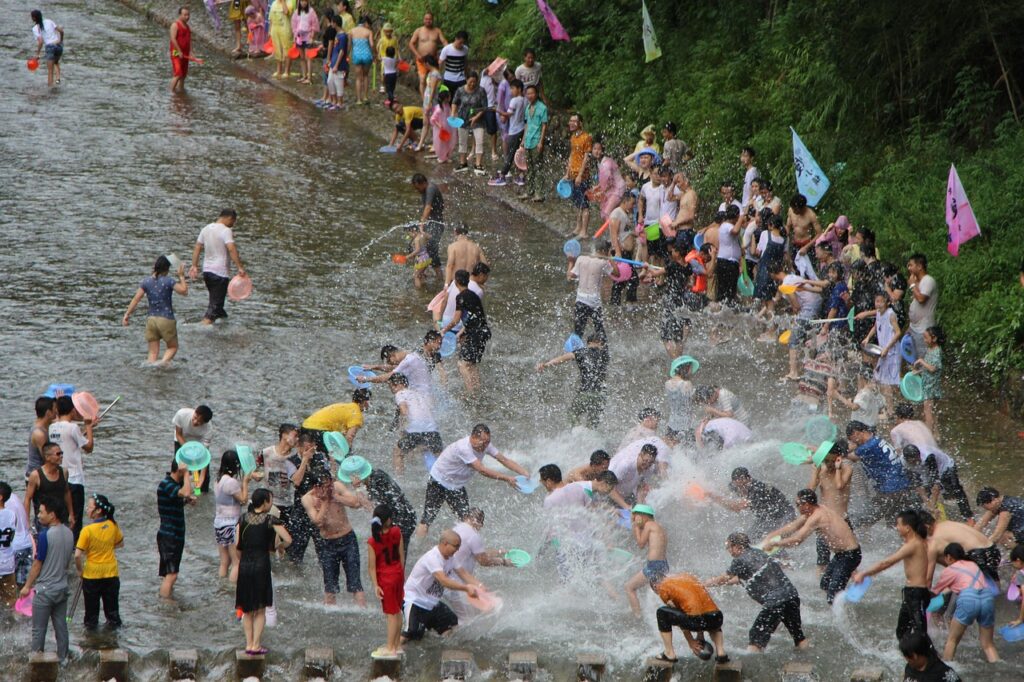
Where: Thailand (nationwide, with major celebrations in Bangkok, Chiang Mai, and Phuket)
When: April 13-15 each year
While many cultures celebrate their new year with fireworks or feasting, Thailand rings in its traditional new year with the world’s biggest water fight. During Songkran, celebrated from April 13-15, the entire country transforms into a giant water battle zone.
Originally, Songkran involved gently pouring water over Buddha statues and the hands of elders as a symbol of purification and washing away the previous year’s misfortunes. Today, while these respectful traditions continue, many Thais and tourists take to the streets armed with water guns, hoses, and buckets for a joyful, refreshing celebration.
In cities like Bangkok and Chiang Mai, major streets become pedestrian-only zones where revelers douse each other amid music, dancing, and street food. With April being Thailand’s hottest month, the nationwide water fight provides welcome relief from temperatures that regularly exceed 100°F (38°C).
Strange Sports and Competitions
1. Wife Carrying World Championships: Finland’s Quirky Contest
Where: Sonkajärvi, Finland
When: Annually in early July
In Sonkajärvi, Finland, couples participate in one of the world’s strangest sporting events: the Wife Carrying World Championships. Male competitors carry their wives (or sometimes a teammate who doesn’t need to be a spouse) through a 253.5-meter obstacle course featuring water hazards and barriers.
The competition’s official rules state that the carried participant must be at least 17 years old and weigh a minimum of 49 kg (108 pounds). If she weighs less, she must carry additional weight to meet the requirement. The most popular carrying technique is the “Estonian carry,” where the woman hangs upside-down on the man’s back with her legs wrapped around his neck.
The grand prize? The wife’s weight in beer. The bizarre tradition reportedly originated from the legend of Ronkainen the Robber, who tested potential gang members by having them run an obstacle course with sacks (or women) on their backs.
2. World Toe Wrestling Championship: Footsie Competitions
Where: The World Toe Wrestling Championship takes place in Derbyshire, England, usually at the Bentley Brook Inn in Ashbourne.
When: The event is typically held annually in June, though exact dates may vary each year. If you’re planning to attend or compete, it’s best to check for updates closer to the time!
If arm wrestling seems too mainstream, perhaps toe wrestling is more your style. Since 1974, competitors have gathered in Derbyshire, England, to determine who has the world’s strongest toes.
Participants remove their shoes and socks before locking toes with their opponent in specially designed toe-wrestling rings. Similar to arm wrestling, the goal is to pin your opponent’s foot down. Competitors must win two out of three rounds, alternating between the right and left feet.
The championship begins with the traditional singing of “Toes of the World,” and participants often adopt toe-related nicknames like “Ticklish Tina” or “The Toeminator.” Despite several attempts to have toe wrestling recognized as an Olympic sport, this peculiar competition remains firmly in the realm of unusual festivals.
3. Air Guitar World Championships: Invisible Instrument Mastery
Where: Oulu, Finland
When: August
In Oulu, Finland, the world’s best pretenders gather annually to show off their skills at playing an instrument that isn’t there. The Air Guitar World Championships celebrates the art of mimicking guitar playing with passion and precision—without an actual guitar.
Competitors are judged on technical merit, stage presence, and “airness”—the extent to which they convince the audience they’re playing a real instrument. Each performer plays a one-minute piece of their choosing, followed by a compulsory piece selected by the organizers.
The championship promotes the philosophy that “wars would end and all the bad things would go away if everyone in the world played air guitar.” While that claim remains untested, the event certainly succeeds in bringing together people from across the globe for a celebration of music, performance, and glorious ridiculousness.
Cultural Oddities and Ancient Traditions
1. El Colacho: The Baby Jumping Festival
Where: Castrillo de Murcia, Spain
When: The festival takes place annually on the Sunday after Corpus Christi, usually in late May or June. The exact date varies each year based on the Catholic calendar.
Perhaps the most eyebrow-raising festival on our list occurs in the small Spanish village of Castrillo de Murcia. Dating back to 1620, El Colacho involves men dressed as the Devil in red and yellow jumpsuits leaping over mattresses where local babies born during the previous year are laid out.
This Catholic ritual is said to cleanse babies of original sin and protect them from illness and evil spirits. After the jump, the babies are sprinkled with rose petals and returned to their parents. Unsurprisingly, the Vatican has distanced itself from this unorthodox practice, though locals continue the tradition with pride.
Despite its alarming premise, there have been no reported injuries to babies in the festival’s 400-year history. Still, most visitors prefer to watch rather than place their infants in the jumping zone.
2. Kanamara Matsuri: Japan’s Fertility Festival
Where: Kawasaki, Japan (Kanayama Shrine)
When: The first Sunday of April each year
Each spring in Kawasaki, Japan, thousands gather for a festival dedicated to an unlikely symbol: the phallus. The Kanamara Matsuri (Festival of the Steel Phallus) centers around a local shrine once popular among sex workers praying for protection from sexually transmitted infections.

Today, the festival features phallic-shaped candies, decorations, and three large phallus mikoshi (portable shrines) carried through the streets. One of these, the “Big Iron Penis,” was created based on a local legend about a sharp-toothed demon that hid inside a woman’s vagina and bit off the penises of two young men on their wedding nights. A blacksmith crafted an iron phallus to break the demon’s teeth, saving the day.
Beyond its attention-grabbing imagery, the festival raises money for HIV research and has transformed from a local religious event into an international tourist attraction that promotes open conversation about reproductive health.
3. Frozen Dead Guy Days: America’s Strangest Memorial
Where: Nederland, Colorado, USA
When: Annually in March (exact dates vary each year)
Nederland, Colorado, hosts a weekend festival each March celebrating the frozen remains of Bredo Morstøl, a Norwegian man whose body has been preserved in dry ice in a shed since 1989. His grandson had planned to establish a cryonics facility in Nederland but was deported before realizing his vision. Despite this, arrangements were made to keep Grandpa Bredo frozen.
When town officials discovered the unusual storage situation, they passed an ordinance prohibiting the keeping of dead bodies on private property. However, they granted Grandpa Bredo a grandfather clause exemption, and the festival was born.
Activities include coffin races, a polar plunge, frozen T-shirt contests, and tours of the “Tuff Shed” where Bredo remains preserved at a chilly -60°F. There’s also a “Frozen Dead Guy” lookalike contest and blue-themed foods and drinks representing the likely color of the honoree.
Modern Quirky Gatherings
1. Bubble Battles: Soapy Flash Mobs
Where: Various major cities worldwide, including New York City, London, Paris, Tokyo, and more. Iconic landmarks and public squares are common locations.
When: Bubble battles are usually organized spontaneously via social media, but they often take place in the spring and summer months when the weather is favorable for outdoor gatherings. Some cities hold annual or semi-regular events, so checking local event listings or social media groups is the best way to find upcoming battles.
In cities worldwide, people gather in public spaces for massive, organized soap bubble battles. Armed with bubble-making equipment ranging from simple wands to elaborate bubble-producing contraptions, participants fill the air with thousands of iridescent spheres.
These events often take place in iconic locations—like New York’s Times Square or in front of the Eiffel Tower—creating surreal scenes as tourists and locals alike find themselves surrounded by a sudden bubble storm. The events are typically organized through social media and represent a modern form of flash mob, bringing moments of unexpected joy to urban environments.
While not tied to any particular cultural tradition, bubble battles represent the human desire to transform ordinary spaces into playgrounds and to find community through shared, silly experiences.
2. The Underwater Music Festival: Submerged Symphonies
Where: Looe Key Reef, Florida Keys National Marine Sanctuary, USA
When: Annually in July
In the Florida Keys Marine Sanctuary, musicians take their performances to unusual depths—literally. The Lower Keys Underwater Music Festival features scuba divers playing underwater instruments amid the coral reefs of Looe Key Reef.
Musicians play specially adapted instruments like the “trom-bonefish” and “manta-lin” while underwater speakers broadcast pre-recorded music. Participants often dress as mermaids or marine creatures, adding to the surreal underwater spectacle.
Beyond entertainment, the festival aims to promote reef protection and environmentally responsible diving. The aquatic concert highlights the importance of preserving the coral reef ecosystem while creating one of the world’s most unique musical experiences.
3. World Naked Bike Ride: Bare Cycling for a Cause
Where: The World Naked Bike Ride takes place in over 70 cities worldwide, including major locations such as London (UK), Portland (USA), Melbourne (Australia), Madrid (Spain), and Mexico City. Each participating city has its own designated route.
When: The event typically occurs between June and September, depending on the city. Dates vary each year, so it’s best to check the official local event pages for specific schedules.
In over 70 cities worldwide, cyclists shed their clothes for the World Naked Bike Ride, an unusual protest combining nudity, environmentalism, and body positivity. Participants ride either fully nude or partially clothed under the slogan “Bare As You Dare” to draw attention to the vulnerability of cyclists on the road and to promote reduced dependence on oil.
The event began in 2004 and has grown into a global phenomenon, with thousands participating in cities like London, Portland, and Melbourne. While public nudity is typically illegal in most participating cities, authorities often make exceptions for this organized event due to its protest nature and positive message.
Body paint and creative accessories are common, with many riders decorating themselves with environmental slogans or elaborate designs. The atmosphere combines serious activism with celebratory exhibitionism, creating a festival that’s simultaneously a protest, performance art, and party.
Conclusion
These unusual festivals remind us that human creativity knows no bounds when it comes to celebration. Whether throwing tomatoes in Spain, rolling cheese in England, or carrying wives in Finland, these strange traditions connect us to our cultural roots while allowing us to momentarily escape the ordinary.
They demonstrate that joy can be found in the bizarre, the messy, and the unexpected. Next time you plan a trip, consider timing it with one of these extraordinary events—you might find yourself covered in mud, dodging flying fruit, or chasing cheese down a hill.
Have you ever attended an unusual festival? Or do you have one on your bucket list? Share your thoughts and experiences in the comments below—we’d love to hear about your wildest festival adventures!


You May Also Like

The Vibrant Bazaars of Jaipur: A Shopper’s Paradise
