
Core Power: Best Exercises for a Stronger, Leaner Midsection
Let’s be real—everyone loves the idea of having visible abs. But here’s the deal: a strong core is about way more than aesthetics. Whether you’re picking up groceries, chasing after your dog, dancing at a party, or even just standing tall with confidence—your core muscles are quietly doing the heavy lifting. Your core is your body’s powerhouse—it stabilizes your spine, supports your posture, and reduces injury risk.
And no, we’re not just talking about crunches or sit-ups. Core strength goes way beyond that. It involves dynamic movements, stability work, and even your breath. The good news? There are tons of fun, effective, and beginner-friendly exercises you can do—at home or in the gym—that will fire up your midsection like never before.
Ready to ditch the boring crunches and build a midsection that’s strong, balanced, and toned? Let’s explore the most effective core exercises for every fitness level, explain the science behind why they work, and show you how to combine them for maximum results. Get ready to transform your midsection from ordinary to extraordinary!
Understanding Your Core
It’s important to understand what we’re actually working with before we can get started with exercises. Your core isn’t just your abs – it’s a complex system of muscles that wraps around your entire midsection, supporting your spine and helping transfer power between your lower and upper body.
The Key Players in Your Core:
- Rectus Abdominis: These are the “show muscles” – what we typically think of as the six-pack. They run vertically along the front of your abdomen and are responsible for flexing your spine forward.
- Transverse Abdominis: Consider this your natural weight belt. This deep layer wraps horizontally around your spine and helps stabilize your pelvis and lower back.
- Internal and External Obliques: Located on the sides of your abdomen, these muscles help you rotate and bend sideways. Strong obliques not only look great but also protect your spine during twisting movements.
- Erector Spinae: Running along your spine, these muscles help you stand up straight and bend backward. They’re crucial for good posture and preventing back pain.
- Multifidus: These small but mighty muscles connect directly to your vertebrae, providing stability during movement.
- Hip Flexors: While technically not “core” muscles, they work closely with your abdominals and affect your core strength and posture.
- Diaphragm and Pelvic Floor: These often-forgotten components of the core system play crucial roles in breathing and stabilizing your center.
Understanding this complex system helps explain why crunches alone won’t cut it for complete core development. A well-rounded core routine addresses all these muscles through various types of movements:
- Anti-Extension: Preventing your spine from overarching
- Anti-Rotation: Resisting forces that try to twist your spine
- Anti-Lateral Flexion: Resisting side bending
- Hip/Trunk Flexion: The traditional abdominal crunch motion
- Rotation: Controlled twisting movements
Now that we understand what we’re targeting, let’s dive into the exercises that will transform your midsection into a powerhouse of strength and stability.
Foundational Core Exercises for Beginners
If you’re new to focused core training, these exercises provide the perfect foundation. Master these before progressing to more challenging variations.
1. The Basic Plank: Your Core’s Best Friend
The plank might seem simple, but it’s one of the most effective exercises for building core strength and stability.
How to do it perfectly:
- Start in a push-up position, then lower onto your forearms.
- Keep your elbows directly beneath your shoulders.
- Your body should form a straight line from head to heels.
- Engage your core by imagining pulling your belly button toward your spine.
- Keep your neck in a neutral position, eyes looking at the floor.
- Squeeze your glutes and quads to maintain proper alignment.
Pro tip: If you’re struggling, drop to your knees while maintaining a straight line from knees to head. As you get stronger, work up to a full plank.
Why it works: The plank engages almost every core muscle simultaneously while also working your shoulders, arms, and legs. It teaches your core to stabilize your spine in a neutral position—a fundamental skill for all other exercises.
Aim for: Start with 20-second holds and gradually build to 60 seconds. Focus on form rather than duration.
2. Bird Dog: Core Stability in Motion
This exercise might look simple, but it challenges your balance and core stability while strengthening your back.
How to do it perfectly:
- Start on all fours with your hands under shoulders and knees under hips.
- Keeping your back flat and core engaged, simultaneously extend your right arm forward and left leg backward.
- Hold for 2-3 seconds, focusing on keeping your hips level (not rotated).
- Return to the starting position and repeat on the opposite side.
Pro tip: If balance is challenging, start by lifting just the arm, then just the leg, before combining them.
Why it works: The bird dog forces your core to stabilize while limbs are moving—exactly what your core is designed to do in real life. It’s particularly effective for strengthening the lower back muscles.
Aim for: 10-12 repetitions on each side for 2-3 sets.
3. Dead Bug: Core Control and Coordination
Despite its unusual name, this exercise is a gem for developing core stability and coordination.
How to do it perfectly:
- Lie on your back with arms extended toward the ceiling.
- Bring knees up to a 90-degree angle (tabletop position).
- Press your lower back firmly into the floor (this is crucial).
- Slowly lower your right arm behind your head while extending your left leg straight out, hovering above the floor.
- Return to the starting position and repeat with the opposite arm and leg.
Pro tip: If you can’t keep your lower back pressed into the floor, reduce the range of motion or keep one leg in the tabletop position at all times.
Why it works: The dead bug trains your core to stabilize your spine while your limbs are moving—an essential function in everyday life and sports. It particularly targets the deep transverse abdominis muscle.
Aim for: 10 repetitions on each side for 2-3 sets.
4. Glute Bridge: Connect Your Core to Your Lower Body
While primarily targeting the glutes, this exercise is essential for connecting your core to your lower body power.
How to do it perfectly:
- Lie on your back with knees bent and feet flat on the floor, hip-width apart.
- Contract your abs and glutes, then press through your heels to lift your hips toward the ceiling.
- At the top, your body should form a straight line from shoulders to knees.
- Hold for 2-3 seconds at the top, squeezing your glutes.
- Lower with control and repeat.
Pro tip: To ensure you’re using your core properly, think about tilting your pelvis slightly toward your ribcage as you lift.
Why it works: The glute bridge strengthens the posterior chain (back of the body) while teaching your core and glutes to work together—critical for protecting your lower back.
Aim for: 12-15 repetitions for 3 sets.
5. Modified Side Plank: Sculpt Your Waistline
This variation makes the challenging side plank accessible to beginners while still effectively targeting the obliques.
How to do it perfectly:
- Lie on your side with knees bent at a 90-degree angle.
- Prop yourself up on your elbow, keeping it directly under your shoulder.
- Lift your hips so your body forms a straight line from head to knees.
- Hold this position while breathing normally.
- Repeat on the other side.
Pro tip: Focus on lifting your hips as high as possible while keeping your shoulders, hips, and knees aligned.
Why it works: The side plank targets your obliques and quadratus lumborum (a deep core muscle), improving lateral stability and helping sculpt your waistline.
Aim for: Start with 15-20 second holds on each side, building to 45 seconds as you get stronger.
Intermediate Core Strengtheners: Taking It Up a Notch
Once you’ve mastered the basics and built a foundation of core strength, these intermediate exercises will help you continue progressing.
6. Mountain Climbers: Dynamic Core Conditioning
This exercise combines core strengthening with cardio for an effective midsection workout.
How to do it perfectly:
- Start in a high plank position with your hands directly under your shoulders.
- Keeping your core tight and hips level, bring one knee toward your chest.
- Quickly switch legs, as if “running” in the plank position.
- Maintain a strong plank position throughout the movement.
Pro tip: Start slowly to master the form before increasing speed. Your hips should stay level throughout—no bouncing up and down.
Why it works: Mountain climbers engage your entire core while adding an element of cardio and coordination. They particularly target the lower abs and hip flexors.
Aim for: 30 seconds of continuous movement, building to 45-60 seconds for 3 sets.
7. Russian Twists: Rotational Power
This classic exercise targets your obliques while improving rotational strength.
How to do it perfectly:
- Sit on the floor with knees bent and feet flat.
- Lean back slightly, maintaining a straight spine.
- Lift your feet slightly off the ground or keep them planted for less challenge.
- Clasp your hands together and rotate your torso to the right, then to the left.
- Focus on moving from your ribs, not just your arms.
Pro tip: For added challenge, hold a weight or medicine ball. Keep your chest up throughout the movement.
Why it works: Russian twists train rotational strength—crucial for sports and preventing injury during twisting movements in daily life.
Aim for: 15-20 rotations per side for 3 sets.
8. Bicycle Crunch: The Ab-Sculpting Classic
Research by the American Council on Exercise ranked this as one of the most effective exercises for targeting the rectus abdominis and obliques.
How to do it perfectly:
- Lie on your back with hands lightly touching the sides of your head.
- Lift your shoulders off the ground and bring your knees to a 90-degree angle.
- Bring your right elbow toward your left knee while extending your right leg.
- Switch sides in a fluid, pedaling motion.
Pro tip: Focus on quality over speed. The effectiveness comes from the rotation and engagement, not from how quickly you move.
Why it works: Bicycle crunches engage multiple core muscles simultaneously and add the element of rotation, making them more functional than traditional crunches.
Aim for: 12-15 repetitions per side for a total of 3 sets.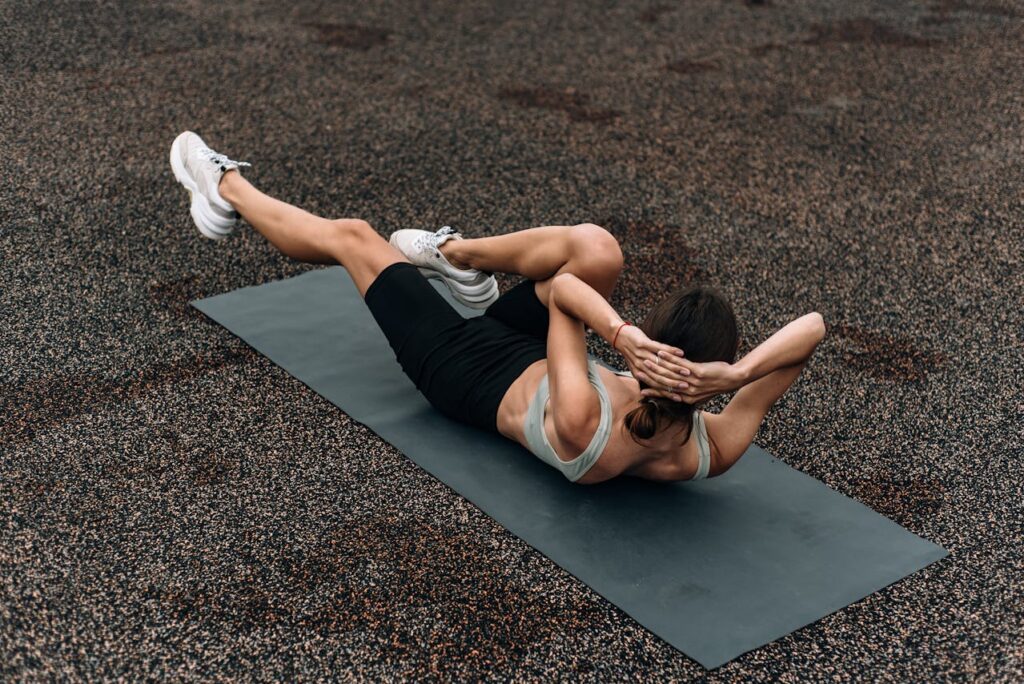
9. Standard Side Plank: Full Lateral Core Strength
This progression from the modified side plank further challenges your obliques and overall core stability.
How to do it perfectly:
- Lie on your side with legs extended and feet stacked.
- Prop yourself up on your elbow, keeping it directly under your shoulder.
- Lift your hips so your body forms a straight line from head to heels.
- Keep your top arm either along your body or extended toward the ceiling.
- Hold this position while breathing normally.
Pro tip: If this is too challenging, you can place your top foot in front of your bottom foot for more stability.
Why it works: The full side plank intensely targets your obliques while also engaging your shoulders, glutes, and legs for total body stability.
Aim for: Hold for 30 seconds on each side, building to 60 seconds over time.
10. Single-Leg Lowering: Lower Ab Focus
This exercise specifically targets the lower portion of your rectus abdominis while teaching core control.
How to do it perfectly:
- Lie on your back with both legs extended toward the ceiling, directly above your hips.
- Place your hands by your sides or under your lower back for support.
- Keeping one leg pointed to the ceiling, slowly lower the other leg toward the floor.
- Stop when you feel your lower back starting to arch off the floor.
- Return to the starting position and repeat with the other leg.
Pro tip: The key is maintaining your lower back connection with the floor. Only lower your leg as far as you can while keeping this contact.
Why it works: This exercise targets the lower abdominals while teaching you to maintain pelvic position during leg movements—crucial for protecting your lower back.
Aim for: 10-12 repetitions per leg for 3 sets.
Advanced Core Training: Elite Strength Builders
Ready to take your core strength to elite levels? These advanced exercises will challenge even well-developed core muscles.
11. Hollow Body Hold: Total Core Integration
This gymnastic training staple builds serious core strength and body awareness.
How to do it perfectly:
- Lie on your back with arms extended overhead and legs straight.
- Press your lower back into the floor by tilting your pelvis slightly.
- Lift your shoulders and legs off the floor simultaneously.
- Your body should form a slight “C” curve.
- Hold this position while maintaining the lower back connection to the floor.
Pro tip: If the full position is too challenging, bend your knees or keep your arms alongside your body until you build strength.
Why it works: The hollow body hold creates total tension throughout your core, teaching all your core muscles to work together as a unit.
Aim for: Start with 20-second holds and build to 45-60 seconds for 3 sets.
12. Hanging Leg Raises: Upper Body Connection
This challenging exercise requires access to a pull-up bar but delivers exceptional results.
How to do it perfectly:
- Hang from a pull-up bar with hands shoulder-width apart.
- Engage your shoulders and core (don’t just hang passively).
- Without swinging, lift your legs up in front of you, keeping them straight if possible.
- Lower with control and repeat.
Pro tip: If straight legs are too challenging, start with bent knees and progress to straight legs as you get stronger.
Why it works: Hanging leg raises target your entire abdominal wall, particularly the lower portion, while also engaging your grip, shoulders, and back.
Aim for: 8-12 repetitions for 3 sets.
13. Plank to Push-Up: Dynamic Core Strength
This exercise combines isometric and dynamic strength for a comprehensive core challenge.
How to do it perfectly:
- Start in a forearm plank position.
- Push up to a high plank one arm at a time (right arm, then left).
- Lower back down to forearm plank one arm at a time.
- Maintain a rigid plank position throughout the movement.
Pro tip: Focus on keeping your hips completely stable—they shouldn’t rock side to side or up and down during the movement.
Why it works: This exercise combines the stability challenge of the plank with dynamic upper body movement, forcing your core to work harder to maintain position.
Aim for: 6-8 repetitions per side for 3 sets.
14. Dragon Flag: Bruce Lee’s Core Secret
Made famous by martial arts legend Bruce Lee, this advanced move builds tremendous core strength.
How to do it perfectly:
- Lie on a bench or sturdy surface and grab behind your head for support.
- Lift your entire body (except your upper back/shoulders) off the bench.
- Your body should form a straight line from feet to shoulders.
- Slowly lower your body back down with control, keeping it rigid.
- Stop just before your lower back touches the surface and lift back up.
Pro tip: Start with bent knees and gradually progress to straight legs as your strength improves.
Why it works: The dragon flag creates enormous tension throughout your entire core, particularly challenging your ability to maintain a rigid position under load.
Aim for: 5-8 repetitions for 3 sets (this is a very challenging exercise).
15. Ab Wheel Rollout: The Ultimate Core Challenge
If you’re looking for one exercise that challenges every inch of your core, the ab wheel rollout might be it.
How to do it perfectly:
- Kneel on a padded surface with an ab wheel in front of you.
- Grasp the handles and position the wheel directly under your shoulders.
- Engage your core tightly and roll the wheel forward, extending your arms.
- Roll out as far as you can without letting your lower back arch.
- Use your core (not your arms) to pull yourself back to the starting position.
Pro tip: Start with partial range of motion and gradually increase as you build strength. Keep your core engaged throughout to protect your lower back.
Why it works: The rollout creates a unique challenge to your core’s ability to resist extension (arching) while under increasing leverage disadvantage.
Aim for: 8-10 repetitions for 3 sets.
Building Your Custom Core Routine
Now that we’ve covered the best exercises for every level, let’s talk about how to build an effective core routine.
Frequency: How Often to Train Your Core
Your core muscles, like any other muscle group, need time to recover and grow stronger. For most people, dedicated core training 3-4 times per week is ideal. Remember that many compound exercises like squats, deadlifts, and overhead presses also engage your core significantly.
Sample Core Routines for Different Goals
For General Fitness (3x weekly):
- Day 1: Plank (3 sets), Bird Dog (3 sets), Russian Twists (3 sets)
- Day 2: Side Planks (both sides, 3 sets), Dead Bug (3 sets), Bicycle Crunches (3 sets)
- Day 3: Glute Bridge (3 sets), Mountain Climbers (3 sets), Single-Leg Lowering (3 sets)
For Athletic Performance (4x weekly):
- Day 1: Hollow Body Hold (3 sets), Russian Twists (3 sets), Side Planks (3 sets)
- Day 2: Plank to Push-Up (3 sets), Bird Dog (3 sets), Dead Bug (3 sets)
- Day 3: Dragon Flag or Hanging Leg Raises (3 sets), Ab Wheel Rollouts (3 sets)
- Day 4: Mountain Climbers (3 sets), Single-Leg Lowering (3 sets), Bicycle Crunches (3 sets)
For Lower Back Health (3x weekly):
- Day 1: Bird Dog (3 sets), Dead Bug (3 sets), Glute Bridge (3 sets)
- Day 2: Plank (3 sets), Side Planks (3 sets), Cat-Cow Stretch (10 repetitions)
- Day 3: Bird Dog (3 sets), Glute Bridge (3 sets), Hollow Body Hold (3 sets, modified if needed)
Progression Strategies for Continuous Improvement
To keep seeing results, you need to progressively challenge your core. Here are effective strategies:
- Increase Duration: For isometric holds like planks, gradually increase the time under tension.
- Increase Reps/Sets: Add repetitions or sets as exercises become easier.
- Decrease Rest Time: Shorten rest periods between sets to increase intensity.
- Add Resistance: Use weights, resistance bands, or more challenging variations.
- Increase Range of Motion: Extend your limbs further in exercises like dead bugs or bird dogs.
- Combine Movements: Once you’ve mastered basic exercises, try combining them (like a plank with leg lifts).
Remember that proper form always takes precedence over progression. Only increase difficulty when you can maintain perfect form.
Common Core Training Mistakes to Avoid
Even with the best exercises, improper execution can limit results or lead to injury. Watch out for these common mistakes:
Mistake 1: Holding Your Breath
Many people unconsciously hold their breath during core exercises. This not only limits oxygen to working muscles but can increase blood pressure and reduce stability. Practice breathing normally throughout all exercises, especially during the most challenging portions.
Mistake 2: Overarching Your Lower Back
Allowing your lower back to excessively arch during core exercises can strain your spine and actually reduce core engagement. Focus on maintaining a neutral spine position or even a slight posterior pelvic tilt (pubic bone tilted slightly up) during most core exercises.
Mistake 3: Training Only the “Six-Pack” Muscles
As we’ve discussed, your core is much more than just the rectus abdominis. Make sure your routine includes exercises that target rotational strength, lateral stability, and back extensor muscles.
Mistake 4: Using Momentum Instead of Muscles
Swinging, jerking, or using momentum reduces the effectiveness of core exercises and increases injury risk. Slow down, control each movement, and focus on feeling the targeted muscles working.
Mistake 5: Neglecting Proper Progression
Jumping into advanced exercises before mastering the basics can lead to compensation patterns and potential injury. Follow a progressive approach, ensuring you can perform each level with proper form before advancing.
Beyond Exercise: Supporting Factors for Core Development
Exercise alone won’t give you a strong, defined midsection. These supporting factors play crucial roles:
Nutrition for Core Definition
You’ve likely heard the saying “abs are made in the kitchen.” While oversimplified, it contains truth. Even the strongest core muscles won’t be visible if covered by a layer of body fat. Focus on:
- Adequate protein intake (0.7-1g per pound of body weight)
- Plenty of vegetables and fruits for micronutrients
- Appropriate calorie intake for your goals
- Consistent hydration (often mistaken for hunger)
- Limiting processed foods and added sugars
Remember that spot reduction is a myth—you can’t lose fat specifically from your abdomen through core exercises. Overall body fat reduction through proper nutrition and total body exercise is the key to revealing your hard-earned core strength.
Recovery and Rest
Your core muscles, like all muscles, grow stronger during recovery, not during exercise. Ensure you’re:
- Getting 7-9 hours of quality sleep nightly
- Allowing 48 hours between intense core sessions
- Managing stress (chronic stress can increase cortisol and promote abdominal fat storage)
- Staying hydrated to support muscle recovery
Posture and Daily Movement
How you hold and move your body throughout the day has a massive impact on core development:
- Practice engaging your core during daily activities
- Be mindful of your sitting posture, especially during long periods at a desk
- Take movement breaks every 30-60 minutes if you work a sedentary job
- Consider a stand-up desk for part of your workday
Conclusion
Building a stronger midsection is about more than aesthetics—it’s about creating functional strength that supports everything you do. By incorporating these evidence-based exercises, following proper progression, and supporting your efforts with good nutrition and recovery, you’ll develop a core that not only looks impressive but serves you well in both athletic pursuits and daily life.
Remember a stronger core supports more than just your body—it fuels your energy, confidence, and lifestyle. So start today and let your core carry you to greatness—one rep at a time. We’d love to hear about your core training experiences! Which of these exercises has worked best for you? Share your journey and questions in the comments below!
Disclaimer: The information provided in this blog is based on my personal experiences and learnings and should not be considered professional advice.


You May Also Like

Yoga: The Ancient Secrets of Modern Living

Dairy Dilemmas: Unraveling the Truth Behind Milk, Cheese, and Yogurt
